
Although in recent years Reiki has become more well known and popular amongst many, there still seems to be an element of the unknown. So today, I thought I would take some time to answer a few of the questions I get asked the most…
What is Reiki?
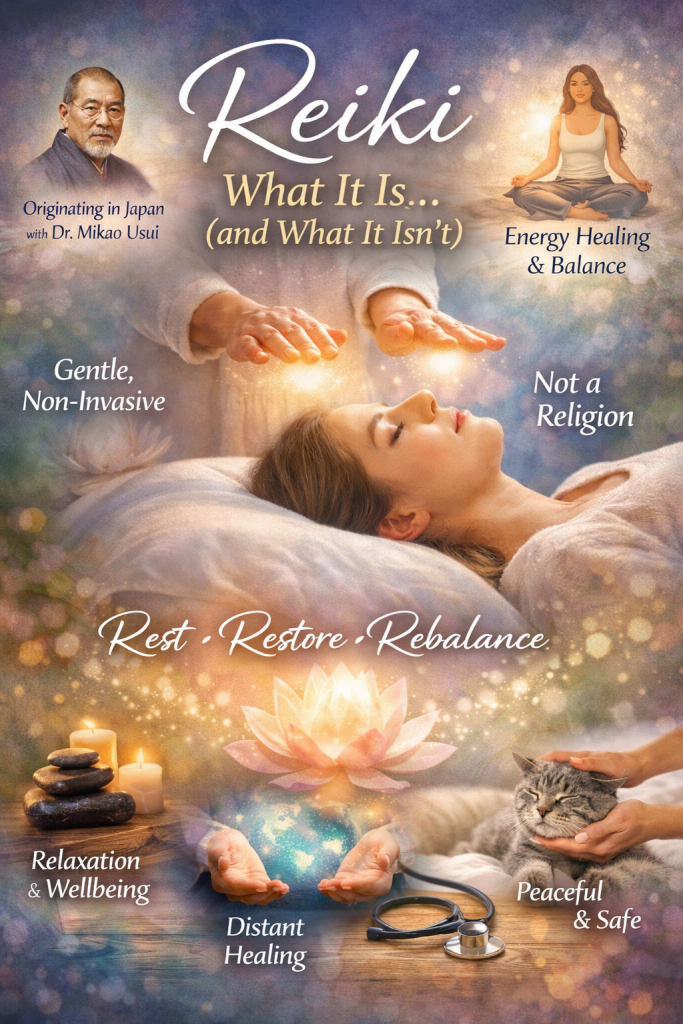
Reiki is a gentle, non-invasive energy practice that focuses on helping to restore balance and support the body’s natural healing abilities. In Reiki, “energy” refers to a subtle life force, described as universal energy, which practitioners work with through intention, presence and gentle touch.
It involves a qualified practitioner placing their hands lightly on or just above the body, with the intention of supporting deep rest, calm, and balance.
Many people who experience Reiki find it deeply relaxing, similar to meditation, or that in-between sleep and awake space, where the body begins to soften and the mind quiets.
Where does Reiki come from?
Reiki originated in Japan in the early 20th century. It was developed by Mikao Usui, a Japanese scholar and spiritual seeker who embarked on a lifelong quest to understand the nature of healing and spirituality. It is widely believed that during a 21-day period of meditation and fasting on Mount Kurama, Usui experienced a profound spiritual awakening. According to tradition, it was during this time that he gained the ability to channel healing energy. He went on to share this practice with others, developing Reiki as a method focused on supporting overall wellbeing.
In addition to developing Reiki as a healing practice, Mikao Usui also established a system of training to support its teaching and practice. Before a practitioner offers Reiki to others, they undergo this training and should receive a series of attunements from a qualified Reiki Master. These attunements are part of the traditional learning process and are intended to open and deepen the practitioner’s ability to connect with and channel Reiki energy.
Reiki training is usually taught in three levels. Level 1 focuses on self-practice and learning the foundations. Level 2 introduces distance Reiki and working more deeply with others. Level 3 is often considered the Master level, where practitioners deepen their practice further and may also train to teach and attune others.
What does Reiki feel like?
Experiences vary from person to person. Some people feel warmth, tingling, or a soft heaviness in the body. Others may experience an emotional release or see vivid colours or images. Some may simply drift into a deeply relaxed state or even fall asleep.
Others feel very little physically during the session, but still leave feeling calmer, clearer, and more grounded afterwards.
There is no “right” experience. Each session is unique to the person receiving it.
What Reiki is NOT…
Reiki is not a religion, and it doesn’t require any belief system, you don’t need to be “spiritual” to receive Reiki.
Reiki is also not a replacement for medical care or professional healthcare.
It’s a complementary practice that supports the body’s natural ability to rest, repair and restore balance.
Does Reiki actually work?
This is a question with more than one perspective, and it deserves a balanced answer.
From a personal point of view, many of the people I’ve worked with who have received Reiki have reported feeling deeply relaxed during and after a session. Some describe feeling emotionally lighter, calmer, and better able to cope with stress for days or weeks after their session. Others have said their pain eased and their sleep improved. Others simply feel more rested, as though they’ve had a chance to pause in a way they don’t often get to in daily life.
From a wellbeing perspective, there is no doubt that deep relaxation itself is beneficial. When the body moves into a calmer state, stress levels reduce, breathing slows, and the nervous system has an opportunity to settle. These physiological shifts are well understood and can influence how we feel mentally, emotionally and physically.
From a research perspective, the evidence around Reiki is still developing. However, some small studies and patient reports suggest that Reiki can have a positive impact on mood, mental health and pain levels, particularly in supportive or palliative care environments. Research also suggests that Reiki may have an influence on the body’s natural healing responses, including shifts in the autonomic nervous system, brain waves and hormones.
Ultimately, whether Reiki “works” really depends on how it is understood, and the experience each person has with it.
Can Reiki really help with stress?
When the body is in a relaxed state, it’s better able to move out of “fight or flight” and into a calmer, more restorative mode. Because Reiki can help encourage deep relaxation, it’s known to support the body in shifting away from stress-based responses.
In this way, it’s believed to assist the body’s natural recovery and self-regulation processes, not by “curing” but by creating the optimum conditions where rest and balance feel more accessible, so the body can do what it is naturally designed to do, rest, repair, and restore balance. Many people find that when stress softens, everything from mood to sleep quality and general wellbeing can feel much more supported as well.
Can Reiki be done at a distance?
Yes. Reiki can also be offered as a distant (or “remote”) practice.
This means the practitioner is not physically in the same room as the person receiving Reiki. And some practitioners (myself included) and clients have reported that this can actually be more beneficial to the client, as they feel more relaxed in their own surroundings and therefore feel a stronger connection to the Reiki.
From a traditional Reiki perspective, distance is not seen as a barrier. The practice is based on the idea that energy is not limited by time or space, and that intention and awareness can be directed beyond that.
As with all Reiki experiences, responses vary. Some people feel it very clearly, while others experience it more subtly or only notice the effects afterwards.
Distance Reiki is often chosen for convenience, comfort, or accessibility, allowing people to receive a session wherever they are, in their own safe and familiar environment.
Do you have to believe in Reiki?
No Reiki does not rely on belief, though being open to the experience is obviously beneficial and can help people to relax into it .
Reiki is often described as something that is experienced rather than something that needs to be fully understood intellectually.
You don’t need to “do” anything, simply be open to receiving it.
Is Reiki safe?
Reiki is considered a safe, gentle and non-invasive practice. You remain fully clothed at all times and physical contact is not necessary.
It involves no physical manipulation or pressure and is often used alongside other wellbeing approaches.
Because of its calming nature, many people find it suitable even during times of emotional stress and physical sensitivity. It can also be suitable for babies, children of all ages, and even animals, in fact, children and animals are often very receptive to it.
However, as with any wellbeing practice, it’s important to work with a qualified practitioner who can assess what feels appropriate for you as an individual. Reiki is intended as a complementary practice and not a substitute for medical care or professional advice.
A final thought…
At its heart, Reiki offers something simple, but often deeply needed… Space!
Space to pause.
Space to soften.
Space to reconnect with yourself, even briefly, in the middle of a busy life.
So whether you feel curious, unsure, or quietly drawn to it, I hope this post might answer a few of your questions.
With warmth, love and light
Lizzi Xx